Feedback from 200 CEO’s: What They Learnt in 2013 & What They Face in 2014

I have been working on the Strategic plan for the Results Group. One of our core Values is “Live what we teach” so it is important to Imagehave a framework in place of quarterly & annual reviews. Any business needs to understand what their clients need and face. I recently wrote about the framework for “Making High Performance Leaders Better” (link here) and something I have spent a lot of time facilitating this year which is “Owning the Voice of the Customer” (Link here). Any company who regularly invests in owning the Voice of their customer not only develops products & services that are of high value but they maintain a Strategic advantage over competitors. This means speaking directly with them often and really hearing what it is you do well, what can improve. It takes an approach of seeking excellence by incrementally getting better & better at core business.

The Results Group helps CEO’s (Business Leaders) to “Lead Change with Certainty”. As part of my research I undertook to ask as many CEO’s to help me as I could. I went out to as many networks as I could. I asked questions on Linkedin, on my blogsite, in person, via e-mail and through both my team and other professionals who work with CEO’s. The result was feedback from just over 200 CEO’s. Many in Canterbury, most from within New Zealand and a decent number from Australia, the USA, Canada and beyond. Many are clients but not all. They are leaders I work with in primarily the world of private business but also there is feedback from the Public sector and larger Corporates. They all lead organisations and people and are CEO/Business Owners. Here are the results which took considerable effort to pull together into key themes. There were many answers as you can imagine so I spent time understanding the key themes/patterns that were common. I asked for the top 3 but feel there are 6 key areas that came through so I have included all 6;

The first question I asked was “As a leader what did you learn in 2013?”

– The importance of Leading by Example: In all you do be genuine, set standards you want others to follow. Be fallible and show that you make mistakes and learn from them, be tough with your staff but ensure they understand what you expect and then that they deliver it. The single most important thing to come through was the importance of being consistent as a leader & in how you deal with people & decisions.

– Empower your People to succeed : Invest heavily in developing, mentoring and training them. Ensure they have not only a clear role that defines what success looks like, but the autonomy to to do the job. Delegate to your staff. Keep them on track often and regularly. Celebrate the wins when they happen (big & small this was a key comment).

– Create a clear Vision & Values Structure: This is especially  important for consistent decision making. It was also critical for the times when the way forward was not “obvious”. It gave a framework for making the important decisions. Speak about “Vision” all the time, make sure the team understand it and align with it and make sure the Values are alive in stories and awards.

– Communicate Clearly & Often: This came up in almost every reply. Be clear in your communications as a leader, set expectations, communicate them often, give good timely and direct feedback so people understand where they stand. Many said they had learnt the importance of communicating the same thing many times to ensure people “get it”. This applied in both large organisations and small ones.

– Have Good Mentors: Mentors internal and external to the business. Have good networks of professional people who want to see the business and those in it succeed. They keep you “real” and things on “track”. Most importantly it keeps you honest as a CEO. The need to ask for and take good advice was a central pattern of comments.

– Include Your Team: This related to including people in both building the plan and in how it will be executed. The need to trust people with information was a key learning as was the need to engage people in the plan. Seeking  feedback on progress, opinions, ideas and on how things could improve was also a central theme.

The Second question I asked was “What are the Challenges you will face as a leader in 2014?”

– Building a Strong Culture: This was a very common theme. The need & desire to build a culture that attracts and retains top talent. In Christchurch this is definitely the number one challenge given that it is a tight labour market. Building a culture that is balanced between high performance and fun, a culture of achieving results. A culture that is a major point of difference over competitors were key challenges for 2014.

– Building Brand: This related to having a clear and strong brand in their particular markets & industry. One that stands for something and is well known. Getting clear on what their brand is and should stand for and being consistent in branding and marketing activities were key actions that needed to be addressed in 2014.

– Recruitment: Of key people. This tied into “Culture” but mainly related to the need and desire to have a good process in place. Challenges included the need to recruit top talent, the time and effort taken to actually run a good process that delivers a skilled recruit that fits the culture & who should be involved. Something mentioned by many CEO’s was the challenge of “understanding young people” and how how to lead them. Sound familiar?

– Leading Change: Change was on the radar for all those responding. The challenge of helping their team to change and to lead the change. A lot of technology change is on the agenda for 2014 i.e. implementation of new systems, software and technology. Changing the business structure also featured abundantly. The need to stay competitive, achieve high levels of staff productivity, introduce and develop new products & services. A key concern was how they were going to do this “when light on details” (plan) or where there was uncertainty on the process needed. Some talked about the “courage” needed by all leaders in the Company to implement change.

– Free up Time: A central theme was the need to delegate to staff more in order to free up time to lead and work on the business. Most were seriously time poor and needed to alter priorities in 2014.

– Learning not to Sweat the Small Stuff: There were many comments about learning to be comfortable leading when there can be no “perfection” and being comfortable with that. There was a recommitment to “bringing back the fun” and a desire to “not take it all so seriously”.

Overall this was a very interesting exercise. It not only engaged a lot of CEO’s to reflect on what they have learnt and on the year ahead but it was the first time I have done this on a large scale. I found leaders genuinely keen to help, to offer their thoughts, who wanted to engage in wider conversations and I learnt a lot. I saw themes & patterns common to all leaders (regardless of the size of the team or organisation they were leading) and themes & patterns relating to Canterbury (with the current post earthquake rebuild) and wider across industries.

The answers above largely tie in with what I have observed over a busy and challenging year closely supporting leaders in change. The desire to build strong cultures that attract and retain top talent being one I certainly have as the number one challenge on the radar for 2014.

What are your thoughts or comments? More importantly have you taken time to reflect on what you have learnt in 2013 as a leader and to define what it is you think you will face in 2014? How will you address the challenges? In my mind leading organisations and leading through others is and remains one of life’s biggest and most rewarding challenges you can face.

Making High Performance Leaders Better

I do a lot of work with high performance leaders. In fact I have just completed a survey which I will share over the coming weeks about their key learnings over the last 12 months and what challenges they expect to face in the next 12 months to bring.

Executive leadership coaching is a growing part of my practise here in Christchurch that is growing by referral and it involves working with high performance, experienced individuals in key leadership roles who want to get better at their craft. This link (read here) explains why leaders need to be aware of their “blind spots” and how some good coaching can take them to a new level of influence over their teams and key people. Leadership at the senior level is about leading through others. In itself this involves coaching, mentoring, developing and getting key managers better at their game…..better a delivering results, better at leading their own parts of the business.

Image

I work with CEO’s in a number of ways. Firstly to help build their strategy and then to help roll it out across the company. Primarily this is about “Business Execution” or executing the strategy. This is a major challenge in amongst the chaos of “Business as Usual.  I now have a number of high performance CEO’s from prominent companies seeking what I term “professional development.” They work virtually or travel from around the country to invest in their own development. This involves working with them in a high trust relationship to get them better at their craft. It involves the following;

a. Being a sounding board. Leadership is a lonely space so having someone with no other motivation except to see them succeed is something that is of high value. Someone outside their organisation, outside their team and outside of the Board of Directors. I have some who simply want to spend time and talk through key decisions and to help them get clear on their thinking and why they think that way.

b. Challenging their Blind Spots. We all have them and this is an area I have worked hard on myself. Better self awareness, better situational awareness of those we lead, key strengths and how to play to them and how to build the skills in your team to cover weaknesses. Empathy for others and tools for getting the best out of people are generally at the top of the list of these important “soft skills”.

c. Building a Framework = Finding Time. Generally CEO’s are very time poor. Finding time for them is key as we challenge how they might structure their week, month & year. A good cadence of team and one on one meetings, time for strategy, review, lessons learnt and strategic thinking all form part of this along with the disciplines required to actually execute such a framework. One of the biggest things I find is that busy leaders do not take time off. They risk burn out, lack balance between work and family life and few give themselves the time to recharge. As a leader of a large organisation you are responsible for feeding a lot of families. You have an obligation to be at the top of your game so you can make the best decisions and deliver the best results. Time out is critical and the discipline to make it a priority is key.

d. Building on Strengths. The best return on investment is to play to and build on your strengths and to build a team around you to do the bits you are not so good at. I find many leaders who beat themselves up for the parts they struggle with and often they focus on these negative areas. Why focus on things you are not naturally good at and tend to loath doing?

e. Execution. Actually supporting leaders to do what they set out to do. Everyone needs accountability and in a space where performance is key everyone needs a push to get out of their comfort zone and to seek excellence. Real situations require practical solutions and one thing I really enjoy is working with leaders to actually do what they need to do.

f. Seeking Excellence. As in high performance sport any % gained is pure gold. It is easy to lift performance from say 65 – 85%. But every % over and above 85% (or however you like to think of it) takes conscious effort, focus, trial and error and execution with a focus on measuring progress. A leader is only as good at their last game so building on performance, banking lessons learnt and pushing outside comfort zones is key.

g. Providing the Right Network. I certainly do not claim to know what it is all about and I challenge anyone who can. Leadership is a journey (not an event) and having the right peer group, mentors, exposure to research, case studies, stories/examples, academic courses and others who are on the same journey is an absolutely critical part of developing talent and talented leaders. I see my role as providing the right things at the right time to build personal networks.

h. Leading in Change & Enabling Culture. The pace of change is fast and continuing to get faster. Technology, competitor moves, globalisation, client expectations, economic conditions have never involved so much change. How do CEO’s lead in times of constant change and how can they enable a culture that top talent wants to be & remain a part of? The culture of an organisation is a strategic advantage that no competitor can steal so enabling a culture of excellence, that is resilient to change, is innovative and close to the customers needs is critical to growing and leading a business.

Working with high performance leaders is one of the things I love about my role. It is satisfying, challenging and I learn a lot about leadership, different sectors and different companies. The common theme is that no one actually teaches you how to lead people & how to get the best out of them. It is not a University course or a seminar or an event. Everyone you meet can & should teach you something and without doubt it is one of life’s ultimate challenges.

Are you working with someone to help you get to the top of your leadership game?

Voice of The Customer Workshop

Voice of The Customer Workshop

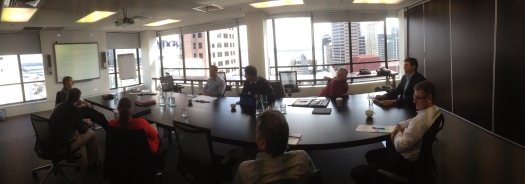
Working with the business development team of EMDA (see their website here) in Auckland last week as they hear from their valued clients exactly how they can take their service to a new level. Already a great company with happy clients but to be able to listen & hear what they need to do to lift the bar is very valuable.

Read more about “Owning the Voice of Your Customer” by linking here.

Standing Up For What is Right…..Never easy!

Always a bit intimidating to have a camera in your face!

Well it has been an interesting week! I wrote my blog last week about the “incident” I experienced after taking a couple of photographs of my wee girl playing netball. (Link here: Political Correctness: Good Guys Don’t Win). Well this was read and commented on all over the country and indeed in places like the USA, Afghanistan and the UK. As they say “it went viral!” Early in the week I was contacted by the Producer of “Campbell Live” about appearing on the show.

Feedback from my blog online and on Facebook  overwhelmingly was one of shock. Shock at our PC society which, on one hand bags fathers (at every opportunity) for not being involved enough in their kids lives, growth, sports and general upbringing, and then on the other hand makes them insecure about what they should or should not do.

Caetana bravely does her bit in front of the camera.

Astonishingly, the issue of parents taking photographs of their kids in public places and being verbally set upon or confronted is common place. Friends and readers relayed similar situations that have either occurred to them or that they have witnessed at sports and school events.

It is not easy thing to put yourself out there so publicly, but there is a time you stand up for what you believe is right. I felt strongly enough to write a blog about it so I reasoned I should be prepared to front the issue in person.

After all this incident had forced us as a family to have to explain the whole situation to Caetana. We’d had to help her understand why it was even an issue that Dad was “told off” by the Police for taking her picture at Netball. She was well aware of “stranger danger” (after Police school programs & Dad’s warnings about getting into strangers cars etc) but explaining the issue around men taking kids photos for the wrong reasons is somewhat more complex I can assure you. We had to decide whether we exposed her to the media as well. We took the decision that it would be a lesson for her in standing up for what you believe in and for me this was one the best lessons that my parents taught me about life. Albeit they went about it outside the media!

My Grandmother was a wee sweetheart, yet as tough as woodpecker lips! She was born in the windswept Shetland Islands (Scotland) and lived by the saying “Be strong and of good courage”.  It is on her headstone and it is something my mother resonates with and in turn I refer to during events in my life. My father always backs his kids in whatever situation “if it is the right thing to do.”

But I guess it is one thing talking and writing about it, it is another actually putting yourself out there for national scrutiny (link here for the Campbell Live Interview). What have I learnt from it all;

  • This is a common occurrence as the large amount of feedback shows,
  • It is a touchy and emotive subject. The right to be a parent and do parent things clashes with those who feel it is their right to protect their kids no matter what.
  • I think it is right to find out who is taking photos but a bit of common courtesy should be maintained and less confrontation and less absolute demands and threats of calling in the Police. How about a bit of common sense and less of the “all men have bad intentions”.
  • Most New Zealanders are seemingly unaware about the laws of photography. If you are in public you actually have no rights to privacy. That is how the media works. The test that courts have applied in the few cases coming before them uses the test “would this be deemed appropriate by a reasonable person”.
  • Overwhelmingly the response has been positive and supportive for making a stand for Dad’s and parents who are not doing anything wrong. 
  • The Police are the good guys. I’m glad they came, it defused what could have been a nasty situation, it reinforced to my daughter that they will help her if she needs them and they quickly summed up the situation and dealt with it a large helping of common sense.
Of course there are the detractors and those of opposing opinion and I accept there always will be but I’m glad I fronted up and said what needed to be said.
Now I can hopefully get back to being a Dad and teaching, growing and guiding a daughter that I am very proud of and one who will add positively to our community.
She was after all the player of the day……..and I missed most of the game!

A Visit to Crete: Some ANZAC Photos

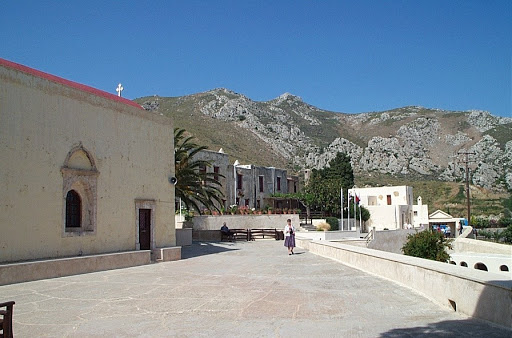
Monastery on Crete where many Kiwis sought shelter after being left behind on Crete.
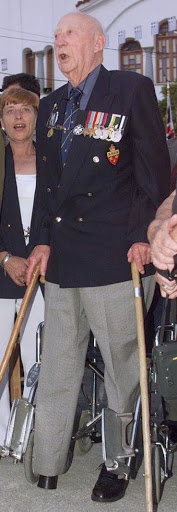
Captain George Brown of Nelson. A good friend of mine who died several years ago. When I visited Crete George was there for the first time since he was wounded, left behind and became a prisoner of war. He was shot in the knee by a sniper and had his leg amputated by a German military doctor. George was the Second in Command of the company which included Charles Upham. It was Charles Upham and a number of other soldiers that ripped a door off a house and carried George in to medical help when he was wounded. This picture was taken at the Galatas memorial for New Zealanders on Crete.

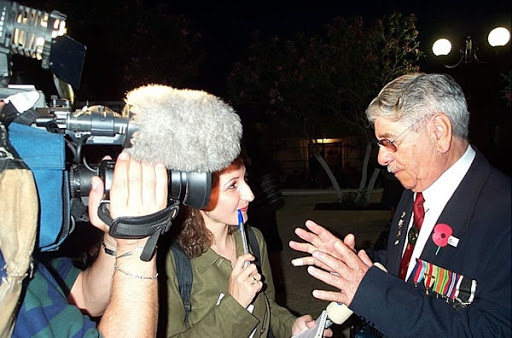
Rangi Sewell was 16 years old on Crete. A member of 28 Maori Battalion, he told some fine stories of his time as a runner. He spent a lot of time taking messages on foot between various units as the german parachute assault took place. He recalls the bayonet charge that the New Zealanders did and in which 28 Maori Battalion took part. I took this picture of Rangi talking to international media.

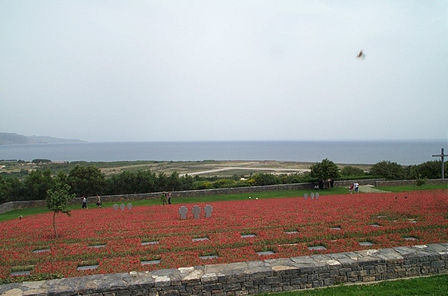
This picture was taken in the main German cemetery on Crete. Looking out to sea an over the Maleme airfield which was defended by the New Zealanders. This airfield was the focus of the German attack and was the scene of fierce fighting. The German cemetery is not allowed to have headstones standing and there are two men in each plot. The German’s are still not so welcome on Crete.

Two South Canterbury Crete Veterans. Both hard cases. Alan Hepburn ( Ashburton) and Bernie Dynes (Pleasant Point, who were in the official party to Crete, in front of the New Zealand memorial at Galatas on the evening of the official New Zealand commemorations, 18 May 2001. Alan was left behind on Crete and was on the run for 12 months. He wept when we visited the monastery and recalled the kindness shown to then and the risks taken by the priests during the German occupation. He was caught by an undercover German officer who asked for the time in English and before he could think he replied. A period of time as a prisoner of war followed.
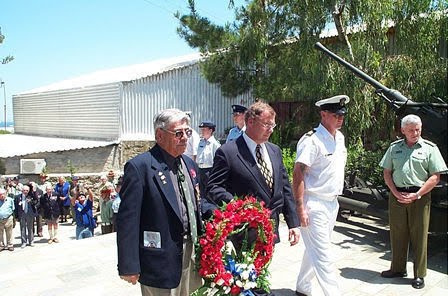
Wayne Mapp, MP (now Minister of Defence), and New Zealand Crete veteran, Sonny Sewell, lay a wreath at the Australian
   memorial at Stavramenos, 18 May 2001


A German veteran of the battle at the German war cemetery, Maleme. I took this photo of this paratrooper after trying to talk with him. He was a nasty bit of work and was not at all friendly.
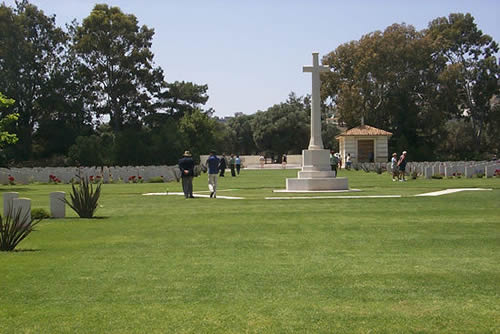
                                  Suda Bay War cemetery. A beautiful spot on the beach front.
Some further historical photos of the battle for Crete link here.
Read more of my stuff by linking here.

Bush Bashing & Finding the Canterbury Lads: Galipolli 2000

I have been to Galipolli twice. The first time I did not land but rather cruised up the Dardanelles on a ship. The next time I joined the small group of NZ soldiers serving in Bosnia with NATO. It was the 85th anniversary of the landings so there was a huge crowd expected. We visited the museum the day before ANZAC day and got our heads around the sheer presence of the place. The museum is packed full of shocking photos, artifacts, human bones and interesting things like bullets that had hit each other in mid air and melded together! It was a day of taking it all in. I visited ANZAC cove where the Kiwis came ashore and saw the first cemetery that had New Zealand men. Many so young, most under 20.

ANZAC cove was quite an emotional sort of a place. As a soldier it was a campaign I had studied and heard so much about. It was a defining moment in the history of our country, certainly of the NZ Army. I think the thing that affected me the most was understanding just how far away from home these men were and just how big the task was they were expected to do first up in a long war!

ANZAC day itself was heaving. The Australian and New Zealand Prime Ministers were present and so were a large NZ Army contingent do the formal ceremonial parades and memorial guards. The Bosnia Contingent left two vans in the huge line of traffic and we walked the last few km to the Dawn Service. The road was littered with bumper to bumper traffic and there were many thousands of Aussie and Kiwi backpackers. The sunrise over ANZAC cove and the service gave the place a mystical feel and the crowd was very silent. The bugler doing the Last Post chilled us all.

The rest of the day was spent walking up the cliffs and visiting the ceremonys and many different battle memorials. I enjoyed the main Australian service at “Lone Pine” and then the New Zealand ceremony at the “Chunk Bair” memorial. The New Zealand Defence Force Cultural Group performed the Haka and the Prime Minister spoke. Turkish soldiers had a very high profile presence as part of the security. This first photo was taken at the Chunuk Bair Memorial.

After the service and reading the role of those killed from many New Zealand Regiments, we decided that rather than take the long track back down the cliffs, the direct “bush bashing route down a large ridge line would be a better way to get to the vehicles. The Infantry Section that was with us led the push with the scouts up front finding the way through heavy scrub, blackberry type bush, rusted equipment and trenches. After  a long walk through a river bed finding small plots full of Indian and Canadian soldiers, we came across a small cemetery of 25-30 plots. Closer inspection found it was in the main full of men from the Canterbury Regiment at “Outpost 1”.  This second picture is taken in this quiet spot.

Researching it after I returned to NZ it seems these men were killed trying to outflank the enemy. Caught in the open by raking machine guns. Our drivers walked back for the vehicles while the remainder of us waited in the sun in that quiet spot for several hours. I spent the time reading each headstone and leaving poppies.  It felt good to be with these guys for a while because given their location so far from the main walkways it was obvious not many visited them.

Gallipoli for me was just somewhere I had to go in my life. It was a “bucket list thing” I now realise and the experience was amazing. Turkey is such a full on diverse place but the people are warm and friendly and whilst they without doubt enjoy the tourists dollars that the area brings, they genuinely seem to care. The plots and sites are well tended and looked after and their attitude is quite refreshing. Then there is the carpet trade they rob you blind on, but that is another story!

As ANZAC day rolls around I always reflect on those guys who stepped up, got stuck in and now lie so far from home. That is why we remember them.

Like this article? Other ANZAC Tributes and Topics

ANZAC: Johnny McNutt- A Good Southern Man: RIP Published 21 Apr 10

The “Ted d’Augvergne Bottle in the Hotel” story. A tale of intrigue from Waimate, NZ. Published 19 Apr 10

Who the Hell is Private David Nelson Wright? A local man killed in Vietnam. Published 5 Feb 10


ANZAC: Johnny McNutt- A good Southern Bloke: RIP

(Acting) Major John McNutt (Link to initial article) was killed in Kuwait on the 12th of March 2001. It doesn’t seem like nine years ago to me, but no doubt his family will attest to the passing of time.

John was  a friend of mine. It shocked us all that he was killed on a training exercise by an American bomb. Could have happened to anyone in a simialr training activity! Whilst it was pretty random, I guess you have to remember that calling in close air support from a fast jet is tricky and risky. Yet this was an essential skill for someone in Johns role to know.

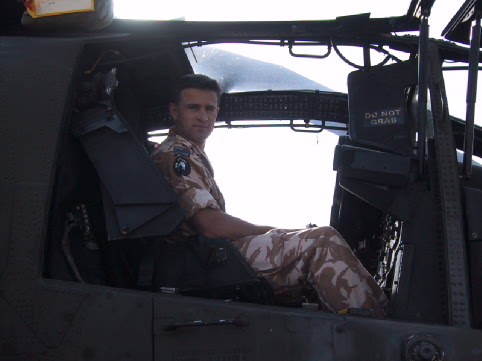
John was a good southern man. He had West Coast blood in his veins and was academically gifted. He had attended St Andrews College and was a graduate of the Australian Defence Force Academy and the Royal Military College (Duntroon)  where New Zealand sends a handful of trainees each year. He was very fit, a mad man on the rugby paddock and well liked. He had been with the New Zealand Special Air Service (NZSAS) for a short period of time only before his posting to Kuwait. This picture shows him sitting in the cockpit of an American Apache helicopter shortly before his death, a man always eager to learn and explore!.

I got to know his family well in the days after his death as I worked to help manage the media interest in the story as the NZ Army got him home to his family. His funeral was huge and it reflected his life. Packed with family, fitness, lots of sport, friends, hunting, the outdoors and a pursuit of adventure. His father Goodwin was a pioneer of the early helicopter deer catching days in Westland (a daredevil in his time) and his mother Mary was lovely, so strong and full of love for her son. Both were amazing in their ability to accept and forgive the cause of the accident.

As ANZAC day looms, I always remember those who made the ultimate sacrifice in service of their country. In Johnny’s case it was a friendly bomb and a bad mistake, but he died on active duty and training so as to excel in his chosen profession of arms.

John McNutt is and will remain well remembered.

Other ANZAC Tributes and Yarns;

The Ted d’Augvergne “Bottle in the Hotel” story.

Who the Hell is Private David Nelson Wright?

Where the Hell is Esk Valley? (Part 2 in the Series "Down Home")

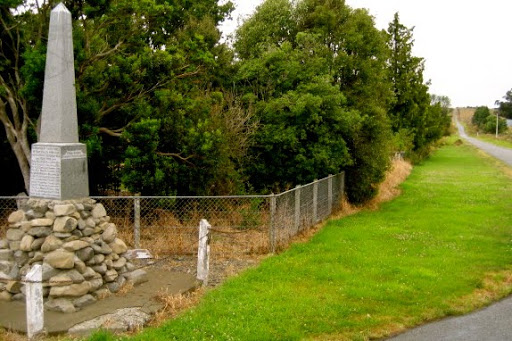
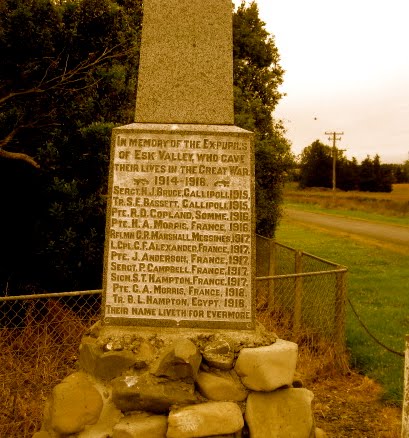
Some 10km from our farm gate is a small settlement called Esk Valley. Esk Valley is really just an intersection and has an old primary school (now closed and used as a day care centre). On the corner is a war memorial which like most farming settlements lists the names (on each side) of those in the district who served in the Boer, First and Second World Wars. Some were killed in action and some made it home to what must have seemed a quiet old piece of paradise compared with the action and adventure they had witnessed. Farmers, young men, stockmen, shepherds and horsemen all volunteered to see the world and came home a bit older than their years for the experience.


Above right: Prominent memorial.


Left: Esk Valley school corner. Looking North up the road towards home.


Right: The old Esk valley School. Now a daycare centre.


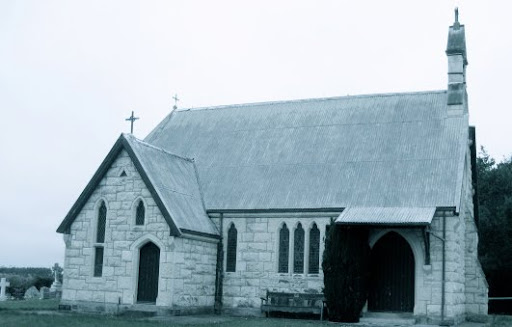
Just up the road on a very prominent ridge sits a historic (and still used) Presbyterian Church called St Mary’s. This is where my grandparents are buried and is I suppose our family plot. I intend to be buried here. With a brilliant view of South Canterbury and surrounded by pastures this church and cemetery is nestled amongst a line of Oaks trees. It could almost be a snapshot of rural England. This is quite a peaceful place and whenever I am home for more than just a few days I often visit here. Over summer when we were swimming at the Otaio Gorge we stopped in twice and I took a few snapshots.


Left: Entrance to St Mary’s lined with oaks.


Right: St Mary’s.


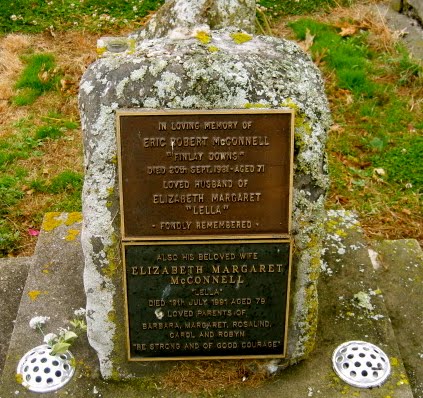
Below: My Grandparents resting place.

On my mothers side of the family I am the eldest of the grandchildren and she is second eldest of five daughters. Her father Eric Robert McConnell was born on our farm and farmed it his entire life. His family originated in County Down, Northern Island and his parents were the original farmers on the property. It was his mother who took the title of the farm due to her husbands illness and this in those days was very unusual. In fact I bear his first two names as my two middle names and I was close to him until his death in 1981. He taught me a lot. 


Eric had a passion for stock and 8mm home movies. He worked hard and the farm still bears the blacksmith and the stables in an age before tractors in which he was born. Too young to fight in the First Word War, farming through the depression, he was given the responsibility of running numerous farms during the next big war as part of the “War Effort”. He was a member of the Home Guard and had an elder brother and a younger brother (Alan served as an Infantry Officer in the Pacific as part of the 3rd New Zealand Expeditionary Force).


My grandmother arrived in New Zealand around the age of 8 years old. The eldest in a large family that came out from the harsh Shetland Islands off the coast of Scotland. Nicknamed “Lella” by family she was small in stature and huge in heart and had a certain hardiness or toughness about her. No doubt a good mix of Scottish and Viking bloodlines. As a school teacher I remember her drumming the times tables and spelling into me and she was reasonably proficient and dishing out the discipline. Prayers before bed was compulsory. She met my Grandfather whilst teaching at the Teschmakers Valley School and living as a boarder with the family. They took years to court and marry and there is a trail of letters they sent to each other as they got to know each other. No broadband internet, cell phones or local bars in those days. It was all very proper!


Resting close to my grandparents is a young soldier who died of wounds in Vietnam in March 1970 aged 23. I have often looked at the headstone of Private David Nelson Wright a fellow Infantryman and wondered what his story was. I did some initial inquiries a number of years ago but recently I queried a number of Vietnam Veterans to find out some more details.


I’ll share these next time.


Other articles about my home you’ll like;


Knowing your own Backyard (Part 1 in the series “Down Home”
The Great South….Camping in Gods Own!

Knowing Your Own backyard: Part one in the "Down Home Series"

We all have a place we call home, be it a house we grew up in, a family property, a business that has been in the family for generations and then there are those who feel home is where their stuff is, or where they carry it (I used to when I was in the Infantry). To many home is where  a number of close family reside, perhaps it is a bach/crib or caravan/tent spot that is an annual pilgrimage.

To me home is our family farm in the Hunter Hills (inland 9km from the sea situated 40 km from Timaru and 27km from Waimate). The 1100 acre property has been in the family since my Great Grand parents started farming it in the early 1900’s. It is green rolling South Canterbury farmland with considerable stands of native bush and an 400 acre hill block called Mt Diamond. I know I am home when I hit this sign post and roar up the drive to my mothers house (seen to the left in amongst the trees in this pic).

As I get a bit older I find myself more interested in the history of the place and like most small New Zealand settlements there is no shortage of it. Over the coming months I intend to write a few blogs with some of the interesting stuff I have stumbled across in my own backyard and the surrounding areas.

Like most farming communitys there have been many changes over the last 10-15 years. There are still the shingle roads and an absence of Police, however gone too are party telephone lines, the local school that both my generation and my mothers attended, churches stand empty, community halls are rarely used and so the list goes on as the tendency for bigger farms alters the landscape. Add in the large number of dairy cows that now occupy an area once firmly sheep and beef country and you have a very different rural landscape.

There are still the local swimming holes (see my recent blog about Otaio Gorge), the local war memorials and farmers who enjoy the land and stock and all that the farming lifestyle brings with it so whilst not all changes have been positive on the local community, there is still a lot going on and it is a great place to call home.

I look forward to sharing a bit of local history.

Other blogs I’ve already written about my home that you’ll  love;

The Great South…..Camping in Gods Own!

Burning Down The House…..New Year 2010

South Island You Rock!…Mt Cook, The Lakes, Central, Tekapo