Leading With Intent

“Leaders are not paid to make the inevitable happen.”

This year has been a reminder that leadership is never static. For many people and organisations across New Zealand and Australia, 2025 has been demanding. Economic pressure, talent shortages, and persistent productivity challenges have been constant themes. Within that context, Pivot & Pace continued to evolve—stretching how we work, embracing AI-enabled processes, and ultimately delivering our strongest financial results to date. That outcome belongs to our entire team.

Greg has been instrumental in our ongoing success. His diligence, capability as a speaker and consultant, relentless work ethic, good humour and steady guidance anchor our business. Marie has continued to be the backbone of our client support and internal business operations, particularly as our service model and tools have evolved significantly. This year we reshaped our support team and welcomed Lisa, who has already strengthened our rhythm and capacity in her Associate and Executive Support role.

Our board also experienced important renewal. We farewelled two outstanding contributors, Denis Snelgar and Stuart Chrisp, whose wisdom and governance stewardship have shaped the firm’s journey. We also welcomed Mark Revis, who brings fresh energy, property and governance experience as we look to our next horizon. What has got us here won’t get us to where we are going!

As a firm, we continued to build on strong strategic partnerships with John Spence, the University of Canterbury, and through our third year sponsoring the Canterbury Civil Contractors’ Annual Awards and fourth year as a key sponsor of the Canterbury Institute of Directors. These relationships, alongside other professional services partnerships, have contributed to our learning, resilience, market insight and, importantly, enduring professional friendships. It also our way of giving back to those who support us.

Alongside the organisational story sits the personal one. Losing Mum in early January brought the year into sharp focus. Acting as executor alongside my brother was challenging but meaningful, and it also enabled us to complete our family farm succession—transitioning it after 110 years to my brother. That is something I am really proud of. It took compromise, challenging conversations and time to achieve my mothers intent & legacy.

This year marked my 21st year of self-employment, our 19th year of marriage (thanks to my wife for the endless support), and Pivot & Pace’s seventh year as a branded entity. I taught two postgraduate university courses, spent 36 days working in Australia across five trips, and managed seven weeks of leave. Our eldest daughter graduated with her Bachelor of Commerce, made the Dean’s List, and earned a scholarship to continue developing her tech start-up (very proud Dad) & our youngest two thrived at school and sport. The death of a good Army mate (who did some work for us at P&P) was tough reminder of how quickly life shifts and its fragility. In April I was awarded the ED by the NZ Army and made the decision to leave the Army on 1 December, concluding 34 years of service.

The data from the year reinforces my ongoing commitment to discipline and wellbeing—something that is a constant challenge. This years numbers include:

• 145 alcohol-free days – started tracking this year: scary

• 10,008 average daily steps – nailed the 10k

• 89 weights sessions and 133 cardio sessions – whew they hurt!

• 467.7 km fast-walked in dedicated workouts – Infantry knees hanging in there!

• 43 minutes of exercise per day on average (up from 34 in 2024) – Yay

• Average sleep of 7 hours 19 minutes – zzzzz need it!

• Cardio fitness above average – LOL I’ll take that as a win thanks Apple watch!

• 78 flights and 46 nights away from home working – It felt a big travel year & was.

• 31 business and biography books read – most things in the world have already been done….learn from others!

We are lucky enough to work closely with many of New Zealand’s admired businesses as they seek to improve, navigate change and implement their strategic goals. The learning is continuous, the expectations are high and the relationships are ones requiring high trust. I am grateful for the opportunities this presents and am constantly amazed at the international, national, industry and regional awards many of our clients have achieved.

It has also been a tough year for all leaders and businesses. Change has been constant. There have been really tough decisions, many courageous conversations and all have worked hard. Some industries have struggled while others have thrived. Through it all there has been a need to exercise judgement and to support key decisions – leadership is never easy.

From a client delivery perspective—relating to my own client work— annual highlights included:

• 26 executives coached individually within our Executive Leadership Programme

• Working closely as a strategist and advisor contracted to 18 different senior leadership teams and a number of Boards.

• 43 board meetings in a formal governance (chairing 34) including my first Australian board chair role.

• 41 strategic implementation planning sessions

• Four keynotes delivered and a black-tie dinner hosted

Across all of this, these key leadership lessons/reflections were my top 5;

  1. When we don’t reflect, we repeat. Reflection, self-awareness and understanding how we are perceived remain such underdeveloped skills in many senior leaders. Without reflection, mistakes recur, opportunities are missed and agility is lost. At a national level, persistent low productivity reflects this gap. Reflection is not a luxury—it is foundational to resilient leadership and building high-performing organisations.
  2. Leaders who avoid the frontline lose relevance. Tied in to point 1, absence at the frontline means leaders are not situationally aware. This erodes customer insight, safety awareness, operational understanding and credibility. Worse than that the opportunity to influence and motivate is lost. Teams acutely feel the absence of their invisible leaders. Leaders who are visible, curious and connected make better decisions—because they are grounded in reality, not assumptions.
  3. A three-year strategy without a long-term vision creates risk. Too many organisations anchor themselves to short-cycle planning that masquerades as strategy. Without a 10-year (or longer) vision and a clear mid-term strategy, companies drift into lists of operational preferences. Long-term intent forces discipline, prioritisation and investment thinking; without it, businesses default to being transactional, constantly needing to react & decline.
  4. Succession remains one of leadership’s biggest failures. Weak talent pipelines, unclear pathways and avoided conversations create disengagement among the very people organisations most need to keep. Boards who have directors with no clear tenure and no succession create the same in their management teams. This year I have seen banks seeking reassurance about board and CEO succession before lending—a signal of how material this risk has become. Succession is not an event; it is an ongoing critical process that requires strong leadership and courage.
  5. Exploitation dominates while exploration is neglected. Many organisations optimise relentlessly for today while underinvesting in exploration. This imbalance increases mid-term risk and erodes long-term value. The leaders who will win the next decade are those who rebalance intentionally and very few organisations invest in the processes to allow both activities to occur concurrently.

Leading with intent does not mean getting everything right. It means owning the learnings, staying connected to people, and intentionally committing to disciplined improvement.

It has been a full year—one I look back on with a mix of satisfaction and pride. Reflection highlighted to me just how much happens over twelve months: the mistakes, the learning & growth, the moments of overwhelm, and of course the wins! It is so easy to forget the great stuff that happens! Being able to laugh, take time out, work as a team and confide in like minded professionals keeps things real and grounded.

A long summer break now beckons. I look forward to returning in 2026 to review & challenge our own business vision and strategy implementation plan – live what we teach! Then to continue the journey alongside the leaders and organisations we are privileged to support as they work to “get it done” amid the complexity of modern business.

What have you learnt in 2025?

Click here to read: My personal family farm succession journey & reflections

Click here to watch a short video outlining what we do and how we do it.

2023: A Year in Leadership – Reflections and Learnings

Heraclitus, an ancient Greek philosopher, once said, “Out of every one hundred men, ten shouldn’t even be there, eighty are just targets, nine are the real fighters…Ah, but the one, one is a warrior.”

This last year I have been very fortunate to support so many of these “warriors”…..the professional leaders charged with the future success of their organisations.

The clarity of a full year of experiences often comes only with some distance. In the thick of the daily grind, time rushes by, filled with daily challenges and tasks. As my 19th year of self employment year ends, an extended break creates that valuable opportunity to pause and reflect.

At Pivot & Pace, we’ve had a dynamic year, providing comprehensive support to diverse & market leading companies. Our focus has remained on helping these organisations to define, adapt, and implement their strategies in the face of ongoing market fluctuations, change and disruption. We’ve seen our Executive and Operational Leader Programmes thrive, catering to the evolving needs of our clients. Our commitment to enhancing governance and succession planning has been ongoing.

In terms of expansion, we’ve broadened our horizons to Auckland and Queenstown, not just with a presence but also in strategic alliances. These partnerships, formed with academic, professional, and commercial entities, are guided by a crucial question: “How do we appear where our future clients are?” This philosophy has streamlined our approach to building trusted relationships and facilitating high value niche services alongside like minded partners.

The year wasn’t without its challenges, marked by highs and lows that are part and parcel of navigating a growing business in a competitive industry. Leadership, to me, is a never-ending journey of personal growth, a constant balance of self-awareness, decision-making, professional judgement and learning to thrive in ambiguity.

As a tradition, I like to reflect on my leadership roles – as Managing Partner, Board Chair, director, father, coach, and strategist – and to identify my key learnings. Here are my significant ones from 2023, in no particular order:

  1. Competition happens at the bottom. Those leading any industry are collaborating together. This year we have focussed on continuing to build on & formalise our strong strategic partnerships. When there is trust, alignment of shared values and mutual respect, this is a game changer in terms of making an impact to clients. Strategic partnerships take time, focused effort, resources and most critically they require the exchange of genuine value & goodwill between all parties involved.
  2. To have a diverse team you need to set them up to succeed. We all know the benefits of having diverse thinkers at the table (different cultures, ages, genders, experiences, education, industry expertise) but in order for them to make an impact and thrive some real consideration is needed to ensure the structures, behaviours and norms evolve to leverage this impact. Too often those who bring much needed different thinking don’t stay because they feel they don’t fit and can’t make an impact. If nothing changes, nothing changes.
  3. Giving time to help others has been some of my most fulfilling work in 2023. Each year I give back to others through some unpaid work. I have coached startup entrepreneurs, emerging directors, post graduate students and others who have who have simply needed a bit of support just to help them through a tough spot. I have personally learnt a lot from these people and they have helped me to explore different thinking and to be more empathetic. The giving works both ways!
  4. “The magic you are looking for is in the work you are avoiding”. Often we gravitate to the work we know, love and get energy from by default. But innovative thinking and the exploration & development of new ideas gets parked simply because of the energy needed and the time to prioritise it. This year I have been encouraged by several mentors to take reflection, listening, curiosity and questioning to another level. This has allowed better insights and has helped me to prioritise what I should be doing for future success.
  5. Real talent is exceptionally hard to find. Our business thrives on talented individuals who are all rounders – they can navigate complex client relationships and deliver strategic insights with impact. Identifying and nurturing such talent remains a key focus & challenge as we move into 2024.
  6. The “sandwich” generation is tricky. 2023 was such a full one year professionally and also personally. Juggling professional demands with personal responsibilities in a year filled with significant family milestones, young children and elderly parents challenges, has been a leadership learning curve in itself.
Our Purpose: “To make an Intentional Impact”

My own key personal achievements this year include:

  1. Wrote the content of a masters level ‘self leadership” paper. This is one of the papers on the University of Canterbury Online Post Graduate Diploma of Strategic Leadership and was a good challenge.
  2. Presented a University of Canterbury MBA & Executive Education Masterclass.
  3. In November 0f 2023 I completed the Institute of Directors “Advanced Directors” Course in Wellington. This was an amazing leadership course alongside a cohort of very experienced directors and with input from some of New Zealand’s most prominent professional directors. I learnt a vast amount about governance, myself and how to navigate complexity and ambiguity in the board room and CEO environment.
  4. Building (with help) a wooden fence around the garden. Sounds simple but over 6 days, 54 post holes (Concreted) with gates and wooden railings this was one of my most satisfying achievements of 2023.
  5. Spoke as the guest speaker at my hometown civic ANZAC service. In fact undertook a number of keynotes and panel events throughout 2023.
  6. Organised a joint 80th birthday party to celebrate both of my parents in November. This was a such a fun experience with 90 family and friends.
  7. Attended my brothers wedding in April which was an awesome farm & family celebration.
  8. Attended the 35th anniversary weekend of my Army Officer Graduating class. This was a great reconnection with good friends who undertook 12 months of leadership training together in a challenging environment.

Some key measured personal metrics of 2023:

  • Facilitated 47 strategic planning sessions.
  • Conducted 218 one on one executive coaching sessions.
  • Attended 60 board meetings as in my capacity as a director (Chairing 28 of them).
  • Advised 14 Boards of Directors.
  • Worked with 19 different Executive Leadership Teams.
  • Consulted to 32 different organisations internationally.
  • Attended 36 networking events.
  • Completed 5 CEO annual appraisals and reviews.
  • Led 20 customised leadership workshops.
  • Travelled on 73 flights, including international.
  • Completed an Oxford University Masterclass and the Advanced Directors Course.
  • Took 8 weeks of annual leave to recharge.
  • 17th year of marriage, 19th year of self employment.
  • 3 healthy children who are all growing, exploring, learning and active.
  • Contracted a clever virtual EA to support my practice.
  • Read 56 books (business and biography).
  • Maintained over the 12 months an average of 7 hours 37 minutes of sleep per night, 30 minutes of exercise each day, and daily average steps of 8625 (7.1km).

2023 was a busy and fulfilling year, one I look back on a think – that was hard but a lot happened! It was a year of post covid normalisation (a new normal), one of constant hustle and one that required a lot of energy.

Luke, Greg, Me: Dec 23

I love what I do and the people I get to share our mission with. I want to acknowledge my business partner Greg Allnutt, MNZM for his endless hard work, laser focus and professional expertise. Complementary skills allow both of us to play to our strengths and this is definitely the leadership & implementation (Combat) multiplier that drives our business success. I also want to thank our team and our independent directors at Pivot and Pace for their hard work and the positive impact they have each day.

To our strategic partners and our valued clients. Thank you, thank you for the opportunity to work with you and to be a small part of your business and leadership success. John Spence, our strategic partner in the USA – you rock!

We have big plans and some great initiatives planned for 2024 and I look forward to starting that journey soon…..maybe after another week or two recharging.

What are your reflections of 2023? What did you learn? What did you achieve?

2 Mins: Leader Communication & Conflict

As a leader communication is a core competency you need to have. Likewise healthy conflict is good as a team collaborates, norms, storms and performs. Ideas are challenged and new ways are discussed. This short clip with John Spence discusses the topic. How do you approach it?

https://youtu.be/5tao57aWqQA

The Pivot: Staying at the Top of Your Game

How do the top performing teams in the world stay at the top of their game? Sports teams, racing teams, leading brands, innovative teams, military teams and many others? What do leaders at the top of their game do to stay at the top? What does this mean for business?

unnamed
The best teams change before change is needed. They pivot and iterate to stay ahead of the crowd.

Right now things in business are going pretty well. There is uncertainty in the medium and longer term as to what is going to happen in money markets, commodity markets, the Chinese/US or EU economies. There is a lot of technology disruption starting to show up on the fringes of even the least tech savvy industries. Change is coming and whether it is disruption, a softening economy, a total global meltdown or even a major political event we will all need to navigate it.

The RESULTS Group work with good companies and proactive leaders who want to get better at what they do. Our clients tend to be the long term brands that over decades have performed exceptionally well. They are actively seeking to stay at the top of their game.

In the next 5-10 years all of us leading (me included) are going to face more change than the world has seen in the last century. It will be fast, ongoing and relentless and will be an exciting and challenging time to lead. Some commentators say we are in year 2 of a 35 year technology disruption. How true is this and how will it affect our own business is open to interpretation but we are all starting to see the wave of change.

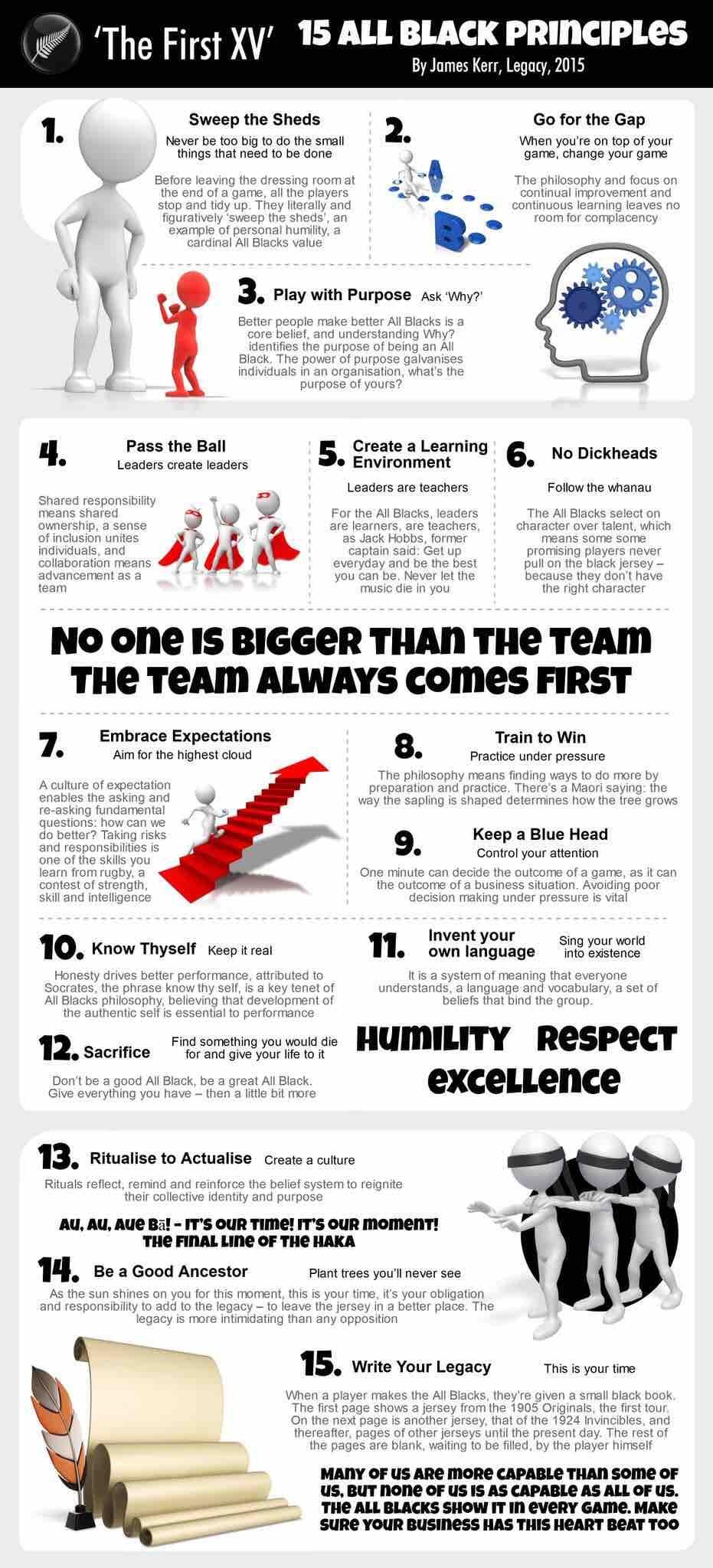
To stay at the top in any professional environment there is a need to develop a culture of continuous learning. If we look at the All Blacks (the most successful global high performance professional sports team/brand with a winning record of 86%, two back to back world cups & recently voted the best team in the world across all codes). In James Kerr’s book “Legacy: What the All Blacks can teach us about the business of life” you will see Chapter 2 is entitled “Adapt”. In essence the commentary is all around “When you are at the top of your game, change your game.” This is about changing consciously before you need to, in order to stay ahead of the competition and to remain the best of the best. To keep an edge or a sustainable point of difference.

IMG_3527
A summary picture of the key chapters & topics of the book “Legacy” by James Kerr.

I like to refer to the term “pivoting”. I saw this in action during some work I recently did at the University of Florida, assessing entrepreneurial engineering teams and the projects they were completing for private business. They were presenting what they had achieved and were seeking feedback so they could iterate and improve their project. They were seeking a “pivot” through good insights and application of ideas.

The best leaders and companies we work with are already pivoting at a time when they are performing well. They know through experience that the good times won’t last. To stay ahead of their competition and to navigate change they must understand what success continues to look like. How do they do this?

Those CEO’s proactively keeping ahead of the crowd prioritise the following;

  • They invest in their own development and leadership skills so they can lead smart innovative people in a collaborative way.
  • They spend time in strategic and operational planning with their teams, senior leadership teams and functional teams. They continuously define the priorities and focus of action.
  • Actively build an aligned plan to execute continuous change and constantly reflect on it, revise it and iterate it to make it better. They empower their people to lead parts for the execution.
  • Focus on execution and getting the important things done.
  • Seek the best advice on technology disruption, the economy, competitors, new entrants and possible substitute products and services.
  • Stay very close to their clients and know what they value, expect and want improved. They build collaborative and close relationships through many channels including social media.
  • Invest in leadership development (and education) and focus on increasing staff engagement to build resilience and an ownership mentality. This aids the change process and brings innovative and collaborative thinking to the fore.
  • Focus on the numbers. What gets measured can be managed.
  • Actively disrupt the companies “business as usual” in a positive way so as to build capacity and capability in a continuous way. This allows the organisation and the team to scale up in a long term sustainable way.
  • Make the tough decisions early.
  • Learn the lessons of previous economic downturns and change projects so as to ensure the same mistakes are not made again, and
  • Recognise success and continue to have fun along the journey.

This all sounds simple (and it is) but it is not easy. It takes focus, good strong proactive leaders committed to ensuring the important things happen and not just the urgent things of modern business. It is about going beyond reactive firefighting and consciously picking & executing the plan for/route to success.

Staying at the top of your game is about changing before you are forced to change. This means having a good team committed to getting incrementally better at what they do.

It is about confidence and momentum.

Just start the journey.


My Memories of 20 Feb 11: Ground zero post the Christchurch Earthquake

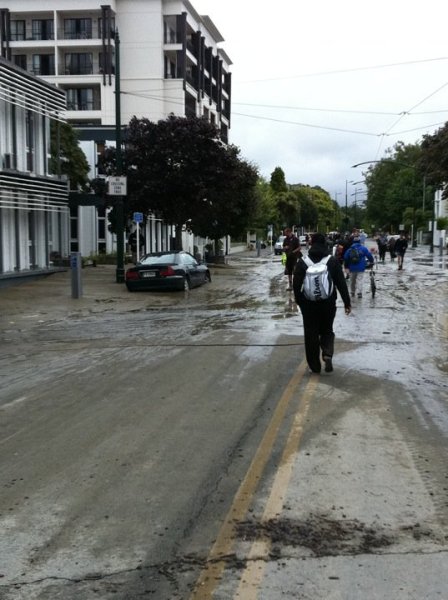
20 February 2011 (5 years ago) at just after 1pm was one that shook is all, a major earthquake. Our office building evacuated & we headed for home. That in itself was going to be challenge with a full central city evacuation under way & bridges out. Short Texts came through to tell me my immediate family were alive & safe. My brothers house was hit by rocks I knew & Dad was in it…..but just how bad things were was to later be a bit of a shock.

I had left the Army in 2004 but was in the throes of rejoining the Army Reserve.

183120_10150109284772297_3400567_n
Central CHCH 1.46pm 20 Feb 11

A call from the XO of the Battalion (the only one to come through in a jammed cell network) redirected me to Army duty. I parked my car and proceeded from Sydenham to the city centre. In my office attire I walked through liquefaction and what was a scene out of a movie. It was 1.30pm.

I walked past a building lying across a lane of Montreal st, stopped to hug a distraught older woman with half a hair dye and foils in. Distraught from watching a bus get crushed she was walking to Oxford 50km away crying.

I overheard builders discussing how they should secure their high rise site and get home.

My task from the Army was to find the Mayor, provide the NZ Defence emergency cell numbers and to proceed to the Civil Defence bunker on Kilmore st. Later I was to discover my wife’s bravery in getting Caetana from school amongst collapsing cliffs and then helping Dad who was trapped in my brothers house that was destroyed by rocks.

The mayors staff had been evacuated after an aftershock from the new gallery building. I passed on the info to Bob Parker & his Ops Manager, gathered a couple of soldiers who were there looking to help and pushed on to find the civil defence bunker, my next task was to fill in as a situation/operations officer until a regular Infantry officer could get in from Burnham. Little did I know it would take many hours for him to arrive.

My first job back in Army service for 7 years.

The bunker was hard to find in the chaos, I passed through the emergency aid station in Cramner square and through many police check points.

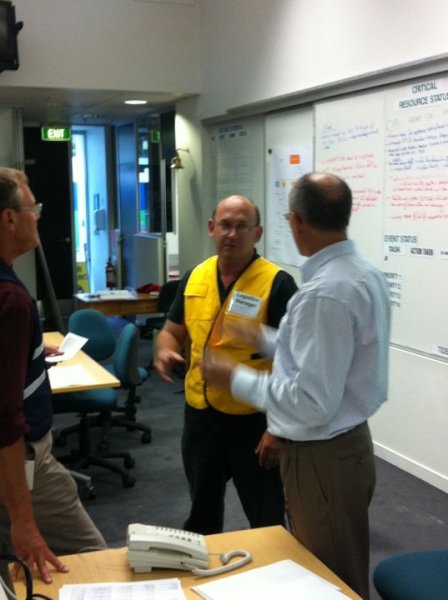
In the bunker I found my old Army boss, Baden Ewart in command. Baden was working in the medical world and was stepping up given that the civil defence staff were in Wellington the day of the quake.

I sat in on the briefing of the current situation and it was apparent that a lot of people were hurt and killed. Early sky TV reports showed the CTV and PGG building collapses and I could hear the fire and police radio traffic spelling out the terrible challenges they faced.

Andrew Howe was the ops officer (an ex army friend and colleague). I was put in an office with the fire liaison officer. All the Army assets were in Timaru in preparation for a large defence exercise and by chance HMNZS Canterbury had docked at Lyttelton minutes prior to the big quake. It was full of armoured and military vehicles and soldiers that would help.

179868_10150109274772297_7016067_n
The Civil Defence Bunker, 20 Feb 11. Andrew Howe and others discuss the situation, approx 4pm

My role was to link between the civil defence command post and the Army command post in Burnham and to support military flights bringing high risk search teams, generators, water treatment units and medical assets into the city. We were coordinating fuel and power for the fire and police services to keep operating and prioritising transport heavy lift and military communications assets.

40 mins into it someone came into the command post and announced that it looked like the Copthorne Hotel might collapse on the bunker. With ongoing large aftershocks hammering the city it was possible although a bit dramatic I thought. Baden said “Langston go out and check that”. So out I went and looked at a 12 story building leaning over and definitely looking like a potential collapse.

My report ” I’m no engineer Baden but it’s not looking flash”. Someone did mention that the bunker was designed to withstand a building collapsing on it but then who would dig us out. WTF?

And so through the shock and chaos a lot of good people worked to make sense of it and to make a difference.

At a little after 7pm I was relieved by an Infantry Captain (he had to park in Riccarton and find the bunker) and walked the 7km around the cordon to my car in Sydenham. A full cordon was in place and with no ID the police made me go the long way through the park and around the 4 avenues. Our office was in the cordon (for 6 weeks) and I arrived at my car covered in mud.

My trip home to Sumner paused at my brothers place where I surveyed the damage, the rocks on his house, the tunnel my dad escaped the 2nd floor from and the boat that had caught fire. Ed was smiling but shaken. My family had tents on the lawn and Dad was quite badly shocked after his experience. We settled into a night of aftershocks, sleeping on the lounger floor and the start of months without water, sewerage or power.

199725_10150155694357297_1789585_n
My brothers house suffering rock damage. My father was lucky to escape unhurt.

I will always remember that day, just how surreal it all was and the part we all played in a difficult situation and uncertain environment.

It was a fitting baptism back into our Army and Months later I received an unexpected letter of commendation from the Brigade commander thanking me for my work that day. Many people did what needed to be done and I was proud to play a small part for the NZ Army.

I never did get around to claiming that first day of army pay (it didn’t seem right) but it was worth it for the adventure & I’ll chalk it up as a donation!

……. And so we remember.

Some of my pictures of that day are attached. We were one of the lucky families that all survived although we were all affected by those who did not.

Leadership Lessons: The 7 Big Leadership Lessons learnt in 2013

I had a great break over Christmas and the New Year choosing to holiday in Western Australia. Hot weather, sun, swimming, wine tours and time with family and friends. Anyone in a leadership role needs time out to recharge (Link here for “Business Leaders need time out) so as to stop, pause, reflect, to do other things and most importantly to plan and refocus on what is coming up.

Last year I wrote about my 5 big Leadership lessons of 2012 (Link here) It was well read and I had a lot of comments back from others reflecting on what they had learnt.

Just prior to Christmas I asked over 200 CEO’s what they had learnt in 2013 and published the summary (link here) and I’m sure this will interest you.

Here are the 7 big leadership lessons that I personally learnt as a CEO, from working closely with other CEO’s and from leading a Reserve Army Infantry Company;

1. You are not in the role to make friends. When you are making consistent, ongoing business decisions there is a need for tough calls at times. It is impossible to please everyone and it is important that the best decision is made with the best information at the time. It is important to set expectations, have the tough conversations, to be consistent with people and to do what is needed for the business. If you communicate, plan, are transparent, guide, support and develop your people then they will respect you but ultimately you are not there to be their friend. You are there to lead. Respect and friendship follow once trust is established.Image

2. Spend more time in planning. I led a lot of change in 2013. Change in clients businesses, change within ours and change within the Army. There were many times that I had to make myself plan in more detail. There were many times I had to push those I was leading and working with to spend more time in planning. Time in planning is seldom wasted. Plan, plan, plan, delegate, plan. Even when the execution phase begins and the plan changes, the fact you did some planning will help in many ways to change the plan if needed.

3. Leadership is a lonely place. There were many times that I felt the need to talk to peers. Peers at the CEO level can be hard to find. 2013 was a year I learnt the true value of mentors, peers and hanging out with like minded people. In fact 2013 was a year it dawned on me just how big the need is for more formal peer groups. This year I plan to form a CEO leadership group to support both my own growth and the growth of others working in this space. Find smart people who want to see you succeed and ask for their support, help, advice or simply hang out with them.

4. Be completely comfortable in your own skin. I think authenticity is an absolute essential element of leadership. Being open, transparent, frank, including others in planning, decision making and problem solving makes things easier. It is easier to take others on the journey with you and it builds a high performance culture. I observe many leaders who like to keep a gap between their work life and personal life. I feel that if you are genuine and authentic then there is no gap. That does not mean you should not have privacy, rather I mean ‘be truly comfortable in your own skin.” Be aware of your own strengths and weaknesses, be comfortable with them and most importantly play to your strengths. Be who you truly are and lead yourself well in the first instance!

5. Be tough on people. Be brave on the people stuff. Be clear in your expectations, lead the way, guide, support and mentor but be consistently tough on your team. Be tough on standards, performance, hitting agreed targets and KPI’s. People need toughness to get the best out of them. Doing their job for them or accepting poor performance not only lets those individuals down but it means the A Players in your team will lose respect for you as a leader and motivation in their work. It is the number one culture killer.

6. The importance of your own leadership framework. As a professional CEO (leader) you must be clear in your framework of planning, meetings, mentoring, communicating & leading through other clever people. It should be possible to drop any professional CEO into any organisation and for that individual to lead it. Take the time to identify and formalise your framework and constantly review, refine and improve it. High performance leaders commit to ongoing training, coaching, mentoring and a life of learning.

7. My heroes are people who get stuff done. I am not into movie stars or celebrities. Rather I respect and enjoy learning from leaders who make stuff happen, people who are brave enough to risk, experience and overcome failure to reach the top of their field. The likes of Mandela, Churchill, Hillary, Buzz Aldrin. I enjoyed reading a book over the break about Air NZ pilot and mountaineer Mike Allsop. I find they are genuine, tell of the fear, effort and lessons learnt and it is possible to learn something from each of them.

So as we line up 2014 as a busy year in business I think it is important for any leader to reflect on what they have learnt and to write them down. Discuss them with your team, peers or family. What did they learn? How can you build on your lessons learnt?

I’m looking forward to the year ahead and the opportunities and challenges that are already on the horizon. How is 2014 looking for you? What are you doing to grow yourself as a leader and in turn those you lead?

Leaders Must Take Time Out

Leaders Must Take Time Out

Like you I am working some pretty long hours to finish all the things that need to be done prior to Christmas. Christmas is after all the ultimate “deadline” and as a leadership tool the “power of a deadline” is a well know tool for execution. People respond well to it. Come Friday this week I am taking 4 weeks off. It sounds pretty cushy I know but the reality is it actually takes planning, hard work and of course a lot of discipline to actually turn the technology off, disconnect e-mail and truly wind down. I wrote about the importance of leaders taking time out (Link here) some time ago when I was with RESULTS.com.

CEO’s, business owners and leaders are the worst at taking their time off and yet they owe it to those they lead to be at the top of their game. They must make good consistent decisions and lead effectively through all the change and pace of modern business. Any company feeds a lot of families and the responsibility of that alone means they should be led well.

So take some time out, truly disconnect, leave the phone at home, turn the e-mail off and divorce the laptop for a few weeks. It is important for you to have time doing other things, pursuing interests, looking after your family and recharging.

Happy Christmas.

Feedback from 200 CEO’s: What They Learnt in 2013 & What They Face in 2014

I have been working on the Strategic plan for the Results Group. One of our core Values is “Live what we teach” so it is important to Imagehave a framework in place of quarterly & annual reviews. Any business needs to understand what their clients need and face. I recently wrote about the framework for “Making High Performance Leaders Better” (link here) and something I have spent a lot of time facilitating this year which is “Owning the Voice of the Customer” (Link here). Any company who regularly invests in owning the Voice of their customer not only develops products & services that are of high value but they maintain a Strategic advantage over competitors. This means speaking directly with them often and really hearing what it is you do well, what can improve. It takes an approach of seeking excellence by incrementally getting better & better at core business.

The Results Group helps CEO’s (Business Leaders) to “Lead Change with Certainty”. As part of my research I undertook to ask as many CEO’s to help me as I could. I went out to as many networks as I could. I asked questions on Linkedin, on my blogsite, in person, via e-mail and through both my team and other professionals who work with CEO’s. The result was feedback from just over 200 CEO’s. Many in Canterbury, most from within New Zealand and a decent number from Australia, the USA, Canada and beyond. Many are clients but not all. They are leaders I work with in primarily the world of private business but also there is feedback from the Public sector and larger Corporates. They all lead organisations and people and are CEO/Business Owners. Here are the results which took considerable effort to pull together into key themes. There were many answers as you can imagine so I spent time understanding the key themes/patterns that were common. I asked for the top 3 but feel there are 6 key areas that came through so I have included all 6;

The first question I asked was “As a leader what did you learn in 2013?”

– The importance of Leading by Example: In all you do be genuine, set standards you want others to follow. Be fallible and show that you make mistakes and learn from them, be tough with your staff but ensure they understand what you expect and then that they deliver it. The single most important thing to come through was the importance of being consistent as a leader & in how you deal with people & decisions.

– Empower your People to succeed : Invest heavily in developing, mentoring and training them. Ensure they have not only a clear role that defines what success looks like, but the autonomy to to do the job. Delegate to your staff. Keep them on track often and regularly. Celebrate the wins when they happen (big & small this was a key comment).

– Create a clear Vision & Values Structure: This is especially  important for consistent decision making. It was also critical for the times when the way forward was not “obvious”. It gave a framework for making the important decisions. Speak about “Vision” all the time, make sure the team understand it and align with it and make sure the Values are alive in stories and awards.

– Communicate Clearly & Often: This came up in almost every reply. Be clear in your communications as a leader, set expectations, communicate them often, give good timely and direct feedback so people understand where they stand. Many said they had learnt the importance of communicating the same thing many times to ensure people “get it”. This applied in both large organisations and small ones.

– Have Good Mentors: Mentors internal and external to the business. Have good networks of professional people who want to see the business and those in it succeed. They keep you “real” and things on “track”. Most importantly it keeps you honest as a CEO. The need to ask for and take good advice was a central pattern of comments.

– Include Your Team: This related to including people in both building the plan and in how it will be executed. The need to trust people with information was a key learning as was the need to engage people in the plan. Seeking  feedback on progress, opinions, ideas and on how things could improve was also a central theme.

The Second question I asked was “What are the Challenges you will face as a leader in 2014?”

– Building a Strong Culture: This was a very common theme. The need & desire to build a culture that attracts and retains top talent. In Christchurch this is definitely the number one challenge given that it is a tight labour market. Building a culture that is balanced between high performance and fun, a culture of achieving results. A culture that is a major point of difference over competitors were key challenges for 2014.

– Building Brand: This related to having a clear and strong brand in their particular markets & industry. One that stands for something and is well known. Getting clear on what their brand is and should stand for and being consistent in branding and marketing activities were key actions that needed to be addressed in 2014.

– Recruitment: Of key people. This tied into “Culture” but mainly related to the need and desire to have a good process in place. Challenges included the need to recruit top talent, the time and effort taken to actually run a good process that delivers a skilled recruit that fits the culture & who should be involved. Something mentioned by many CEO’s was the challenge of “understanding young people” and how how to lead them. Sound familiar?

– Leading Change: Change was on the radar for all those responding. The challenge of helping their team to change and to lead the change. A lot of technology change is on the agenda for 2014 i.e. implementation of new systems, software and technology. Changing the business structure also featured abundantly. The need to stay competitive, achieve high levels of staff productivity, introduce and develop new products & services. A key concern was how they were going to do this “when light on details” (plan) or where there was uncertainty on the process needed. Some talked about the “courage” needed by all leaders in the Company to implement change.

– Free up Time: A central theme was the need to delegate to staff more in order to free up time to lead and work on the business. Most were seriously time poor and needed to alter priorities in 2014.

– Learning not to Sweat the Small Stuff: There were many comments about learning to be comfortable leading when there can be no “perfection” and being comfortable with that. There was a recommitment to “bringing back the fun” and a desire to “not take it all so seriously”.

Overall this was a very interesting exercise. It not only engaged a lot of CEO’s to reflect on what they have learnt and on the year ahead but it was the first time I have done this on a large scale. I found leaders genuinely keen to help, to offer their thoughts, who wanted to engage in wider conversations and I learnt a lot. I saw themes & patterns common to all leaders (regardless of the size of the team or organisation they were leading) and themes & patterns relating to Canterbury (with the current post earthquake rebuild) and wider across industries.

The answers above largely tie in with what I have observed over a busy and challenging year closely supporting leaders in change. The desire to build strong cultures that attract and retain top talent being one I certainly have as the number one challenge on the radar for 2014.

What are your thoughts or comments? More importantly have you taken time to reflect on what you have learnt in 2013 as a leader and to define what it is you think you will face in 2014? How will you address the challenges? In my mind leading organisations and leading through others is and remains one of life’s biggest and most rewarding challenges you can face.

Harvard: The Class of 1963 on Life & Happiness

Harvard: The Class of 1963 on Life & Happiness

A great read (link here). The more I hang out with successful people the more I understand that doing the basic things extremely well (i.e. better than the average person), finding a role you are extremely passionate about and having a good balance of work (family, friends and your own time) are the key to making it a reality.