The Army is a culture of history, rituals, traditions and story telling. Soldiers tell stories of hardship, often using humour as a medium. Taking the piss out of one another, laughing when things get tough, keeping it real and connecting with each other. One of the things I loved about being a professional soldier and now as a Battalion Commander in the Army reserve is the camaraderie of being part of an Infantry unit. Like minded people, prepared to serve connected by common purpose, experience and at times hardship, overseas and in harms way.
South West Africa, 1996
In fact we as humans are genetically hardwired to tell stories. In ancient times in all cultures the art of storytelling was the the “google” of the time. This was how methodology, family history and lessons learnt were passed on to the next generation. It was human connection, the entertainment of the time, education of the time and the essence of tribe.
In the modern world this lives on in movies, youtube, games, the entertainment industry, book etc. In many ways things have not changed even if the methods of delivery might have. As a leadership tool the ability to connect people through stories is a skill that greatly enhances effectiveness. Telling a story is a great way to teach, inspire, influence and connect. The best CEO’s and leaders I know are the best storytellers. I love Tom Peters analogy “Manage by storying about”.
Here is 2 mins on the subject from a recent leadership panel I took part in;
I have just spent several days working with a large listed Australian company at an offsite in the Blue Mountains. They were taking their Strategic plan and consciously building their plan to executethe Strategy. Typically you should spend as much time planning the execution as you do making the Strategic plan and yet this is rarely done.
This is core business for Advisory.Works as our clients know & it prevents one of the biggest frustrations in business today: A lack of execution. Nothing happens…..a great plan is never realised, it sits on the shelf and gathers dust. This is total insanity & so often Business Leaders wonder why their fantastic Strategic plan never ever gets executed. How can it?
Here are a few thoughts on Disciplined Execution from a recent CEO Leadership Panel I was part of in Christchurch.
A valuable video full of some valuable ideas on Strategic Planning and Strategic Execution from Business thought Leaders and Leadership expert John Spence.
We are passionate about disrupting Business Advisory.
In fact our Company Mission is to totally disrupt Business Advisory by 2020 as we continue to evolve a premium Advisory Brand focussed on Disciplined Execution and High Performance Leadership.
Why?
Lets face it the current status quo really has to change to meet the demands of modern business leaders who seek support in solving complex problems. Problems created by the increasing pace of constant change and disruption.
Too often conservative middle aged men sit in judgement, dispensing advice backed by education and professional development that ended in the 1990’s and talking about solutions that have worked historically.
At its worst traditional Advisers expect to charge a premium for this advice and yet they have never walked in the shoes of those they seek to influence. They have never led a business, never risked all as an entrepreneur and they don’t have the scars, stories and lessons learnt from experiencing failure, success and from practical application. They are not people leaders and yet they seek to advise, develop & influence leaders who are.
Worse still they don’t typically ask their clients for any feedback nor ensure that what they are doing is effective & of value value. They struggle with practical application of theory & struggle to get clients to execute their advice. Often there is constant muttering & frustration as to why this happens.
I personally have worked with many professional services companies who openly state they are client centric and yet they seek no client feedback. Their fees are dropping so they finally forced to react and seek change.
In one case it had been 12 years since a company had completed any feedback survey of their clients. Think about the arrogance of that. They assume they know what it is their clients need but never go beyond individual opinions.
When surveys are finally deployed they discover to their horror that their current reality does not match their assumptions and that they have a huge training, R & D and leadership development gap to close. Too complacent and comfortable to really care about their clients needs.
Many times I have challenged an absurd desire to spend time refocussing on their client relationships prior to measuring client loyalty or engagement because they fear the results.
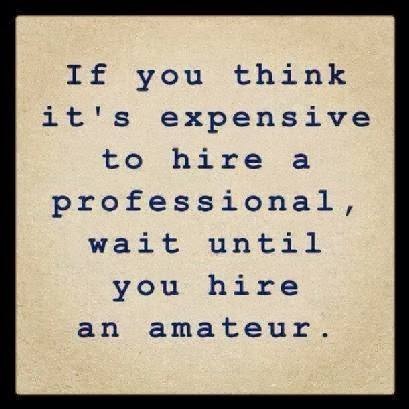
Wait until you hire an amateur…..makes you realise the value of having a professional on board.
Business Advisors of the future must;
Be experienced leaders who lead by example with their own Business practices and actively see themselves as leaders and influencers. Advisors who make things happen, can influence people through real stories of practical application and who can coach, mentor and guide other clever people. They must have people skills (EQ) and empathy.
Own the voice of their customer. They must have an up to date (& data based) understanding of what their customers really want and need. In fact the top advisers are pro-active and bring solutions to their customers before they know they need them. They anticipate needs rather than react to immediate situations.
Have humility and respect always.
Be future focussed and have a passion for lifelong learning. If you are as good as you will ever be it’s just not going to cut it. Academic qualifications are table stakes and the start point not the end game. They must provide clarity and inspire confidence for those they serve by constantly up skilling and learning.
Bring researched frameworks & networks of like minded people. The day of the individual guru with all the answers is gone. Business today is simply too complex to know everything. The best Advisors will connect customers to other leaders, professional advisors and collaboratively bring unique solutions to complex problems.
Measure and manage & clearly demonstrate massive value. This will not always be financially driven either, rather it will vary from customer to customer.
So thats why we do what we do. These are but some of the reasons we are on a mission to disrupt Business Advisory. Business leaders expect and need more and this is not opinion….. we ask them regularly and have done for many years.
I am lucky enough to guest lecture at the University of Canterbury at the School of Business and Law. Supporting Masters level and MBA students with access to real life business opportunities and thinking is something I am passionate about. In July I introduced my good friend John Spence (Find out more about Top 100 Business Thought Leader John Spence here) to UC to speak about “Leading in Constant Change”. Here is his presentation.
This is an edited version of a leadership panel I took part in during a recent visit to Florida. It involves leaders from Infinity Energy, Santa Fe College & the University of Florida and covers the topics of Leading in Business today, change, disruption, execution and the challenge of leading people. The audience includes 135 business members from the Gainesville Chamber of Commerce. I learnt a lot taking part in this and it makes for some interesting topics.
How do the top performing teams in the world stay at the top of their game? Sports teams, racing teams, leading brands, innovative teams, military teams and many others? What do leaders at the top of their game do to stay at the top? What does this mean for business?
The best teams change before change is needed. They pivot and iterate to stay ahead of the crowd.
Right now things in business are going pretty well. There is uncertainty in the medium and longer term as to what is going to happen in money markets, commodity markets, the Chinese/US or EU economies. There is a lot of technology disruption starting to show up on the fringes of even the least tech savvy industries. Change is coming and whether it is disruption, a softening economy, a total global meltdown or even a major political event we will all need to navigate it.
The RESULTS Group work with good companies and proactive leaders who want to get better at what they do. Our clients tend to be the long term brands that over decades have performed exceptionally well. They are actively seeking to stay at the top of their game.
In the next 5-10 years all of us leading (me included) are going to face more change than the world has seen in the last century. It will be fast, ongoing and relentless and will be an exciting and challenging time to lead. Some commentators say we are in year 2 of a 35 year technology disruption. How true is this and how will it affect our own business is open to interpretation but we are all starting to see the wave of change.
To stay at the top in any professional environment there is a need to develop a culture of continuous learning. If we look at the All Blacks (the most successful global high performance professional sports team/brand with a winning record of 86%, two back to back world cups & recently voted the best team in the world across all codes). In James Kerr’s book “Legacy: What the All Blacks can teach us about the business of life” you will see Chapter 2 is entitled “Adapt”. In essence the commentary is all around “When you are at the top of your game, change your game.” This is about changing consciously before you need to, in order to stay ahead of the competition and to remain the best of the best. To keep an edge or a sustainable point of difference.
A summary picture of the key chapters & topics of the book “Legacy” by James Kerr.
I like to refer to the term “pivoting”. I saw this in action during some work I recently did at the University of Florida, assessing entrepreneurial engineering teams and the projects they were completing for private business. They were presenting what they had achieved and were seeking feedback so they could iterate and improve their project. They were seeking a “pivot” through good insights and application of ideas.
The best leaders and companies we work with are already pivoting at a time when they are performing well. They know through experience that the good times won’t last. To stay ahead of their competition and to navigate change they must understand what success continues to look like. How do they do this?
Those CEO’s proactively keeping ahead of the crowd prioritise the following;
They invest in their own development and leadership skills so they can lead smart innovative people in a collaborative way.
They spend time in strategic and operational planning with their teams, senior leadership teams and functional teams. They continuously define the priorities and focus of action.
Actively build an aligned plan to execute continuous change and constantly reflect on it, revise it and iterate it to make it better. They empower their people to lead parts for the execution.
Focus on execution and getting the important things done.
Seek the best advice on technology disruption, the economy, competitors, new entrants and possible substitute products and services.
Stay very close to their clients and know what they value, expect and want improved. They build collaborative and close relationships through many channels including social media.
Invest in leadership development (and education) and focus on increasing staff engagement to build resilience and an ownership mentality. This aids the change process and brings innovative and collaborative thinking to the fore.
Focus on the numbers. What gets measured can be managed.
Actively disrupt the companies “business as usual” in a positive way so as to build capacity and capability in a continuous way. This allows the organisation and the team to scale up in a long term sustainable way.
Make the tough decisions early.
Learn the lessons of previous economic downturns and change projects so as to ensure the same mistakes are not made again, and
Recognise success and continue to have fun along the journey.
This all sounds simple (and it is) but it is not easy. It takes focus, good strong proactive leaders committed to ensuring the important things happen and not just the urgent things of modern business. It is about going beyond reactive firefighting and consciously picking & executing the plan for/route to success.
Staying at the top of your game is about changing before you are forced to change. This means having a good team committed to getting incrementally better at what they do.




 Leading from the front