Leading: The Fine Art of Story Telling

The Army is a culture of history, rituals, traditions and story telling. Soldiers tell stories of hardship, often using humour as a medium. Taking the piss out of one another, laughing when things get tough, keeping it real and connecting with each other. One of the things I loved about being a professional soldier and now as a Battalion Commander in the Army reserve is the camaraderie of being part of an Infantry unit. Like minded people, prepared to serve connected by common purpose, experience and at times hardship, overseas and in harms way.

Angola
South West Africa, 1996

In fact we as humans are genetically hardwired to tell stories. In ancient times in all cultures the art of storytelling was the the “google” of the time. This was how methodology, family history and lessons learnt were passed on to the next generation. It was human connection, the entertainment of the time, education of the time and the essence of tribe.

In the modern world this lives on in movies, youtube, games, the entertainment industry, book etc. In many ways things have not changed even if the methods of delivery might have. As a leadership tool the ability to connect people through stories is a skill that greatly enhances effectiveness. Telling a story is a great way to teach, inspire, influence and connect. The best CEO’s and leaders I know are the best storytellers. I love Tom Peters analogy “Manage by storying about”.

Here is 2 mins on the subject from a recent leadership panel I took part in;

The Pivot: Staying at the Top of Your Game

How do the top performing teams in the world stay at the top of their game? Sports teams, racing teams, leading brands, innovative teams, military teams and many others? What do leaders at the top of their game do to stay at the top? What does this mean for business?

unnamed
The best teams change before change is needed. They pivot and iterate to stay ahead of the crowd.

Right now things in business are going pretty well. There is uncertainty in the medium and longer term as to what is going to happen in money markets, commodity markets, the Chinese/US or EU economies. There is a lot of technology disruption starting to show up on the fringes of even the least tech savvy industries. Change is coming and whether it is disruption, a softening economy, a total global meltdown or even a major political event we will all need to navigate it.

The RESULTS Group work with good companies and proactive leaders who want to get better at what they do. Our clients tend to be the long term brands that over decades have performed exceptionally well. They are actively seeking to stay at the top of their game.

In the next 5-10 years all of us leading (me included) are going to face more change than the world has seen in the last century. It will be fast, ongoing and relentless and will be an exciting and challenging time to lead. Some commentators say we are in year 2 of a 35 year technology disruption. How true is this and how will it affect our own business is open to interpretation but we are all starting to see the wave of change.

To stay at the top in any professional environment there is a need to develop a culture of continuous learning. If we look at the All Blacks (the most successful global high performance professional sports team/brand with a winning record of 86%, two back to back world cups & recently voted the best team in the world across all codes). In James Kerr’s book “Legacy: What the All Blacks can teach us about the business of life” you will see Chapter 2 is entitled “Adapt”. In essence the commentary is all around “When you are at the top of your game, change your game.” This is about changing consciously before you need to, in order to stay ahead of the competition and to remain the best of the best. To keep an edge or a sustainable point of difference.

IMG_3527
A summary picture of the key chapters & topics of the book “Legacy” by James Kerr.

I like to refer to the term “pivoting”. I saw this in action during some work I recently did at the University of Florida, assessing entrepreneurial engineering teams and the projects they were completing for private business. They were presenting what they had achieved and were seeking feedback so they could iterate and improve their project. They were seeking a “pivot” through good insights and application of ideas.

The best leaders and companies we work with are already pivoting at a time when they are performing well. They know through experience that the good times won’t last. To stay ahead of their competition and to navigate change they must understand what success continues to look like. How do they do this?

Those CEO’s proactively keeping ahead of the crowd prioritise the following;

  • They invest in their own development and leadership skills so they can lead smart innovative people in a collaborative way.
  • They spend time in strategic and operational planning with their teams, senior leadership teams and functional teams. They continuously define the priorities and focus of action.
  • Actively build an aligned plan to execute continuous change and constantly reflect on it, revise it and iterate it to make it better. They empower their people to lead parts for the execution.
  • Focus on execution and getting the important things done.
  • Seek the best advice on technology disruption, the economy, competitors, new entrants and possible substitute products and services.
  • Stay very close to their clients and know what they value, expect and want improved. They build collaborative and close relationships through many channels including social media.
  • Invest in leadership development (and education) and focus on increasing staff engagement to build resilience and an ownership mentality. This aids the change process and brings innovative and collaborative thinking to the fore.
  • Focus on the numbers. What gets measured can be managed.
  • Actively disrupt the companies “business as usual” in a positive way so as to build capacity and capability in a continuous way. This allows the organisation and the team to scale up in a long term sustainable way.
  • Make the tough decisions early.
  • Learn the lessons of previous economic downturns and change projects so as to ensure the same mistakes are not made again, and
  • Recognise success and continue to have fun along the journey.

This all sounds simple (and it is) but it is not easy. It takes focus, good strong proactive leaders committed to ensuring the important things happen and not just the urgent things of modern business. It is about going beyond reactive firefighting and consciously picking & executing the plan for/route to success.

Staying at the top of your game is about changing before you are forced to change. This means having a good team committed to getting incrementally better at what they do.

It is about confidence and momentum.

Just start the journey.


The Power of “Lessons Learnt” & “Reflection”

unnamed
The definition of insanity – Doing the same thing over and over again and expecting a different result.

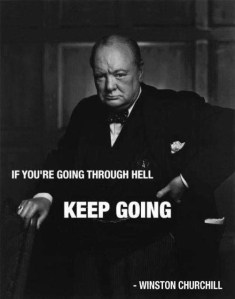
There is a lot of research that shows the best lessons are learnt through experience and from failure. Failures can be big and small ranging. One of the leaders I admire is Winston Churchill. I have read so much of his writing and the various biographies and speeches. He had some of the most fantastic failures and also some biggest successes. His early years were a disaster and yet he went on to lead Britain and the Commonwealth to victory over Germany in the second world war. He adapted, reflected and used what he had learnt and the resulting resilience he built.

Hell
When going through hell keep going!!

Most long serving Business Owners and CEO’s have made some big mistakes over their career. Economic changes, currency fluctuations, competitor moves, technology changes have taken most close to the brink at some stage and we add to that the complexity of some bad decisions, no decisions or not changing fast enough. In fact some would say if you haven’t pushed things a bit then you are not even close to peak performance.

The ability to see mistakes early comes from that skill of being able to reflect. As a leader at any level you need to consciously build on that “gut feel” to really understand and reflect on what you are seeing; in the work place, after a meeting, in a project review, after a client discussion, during a Strategic Execution review etc. So often the skills a high performing senior leader seeks to intentionally develop is that ability to self reflect, to be able to change a bad situation, a failing plan or iterate on an initial decision. To be able to understand the impact he or she is having, needs to have and who/what needs to be influenced to achieve success. This allows a Company to move faster and to build on performance.

The ability to understand and interpret (make a professional judgement) what you are seeing, validate it by seeking feedback in many ways and to constantly learn lessons is a very valuable skill. It is especially challenging when it is “cultural/the people” stuff we are needing to interpret especially to support change. I enjoy coaching these skills and you never stop learning from others.

So some of the best leaders also have the best battle scars and the best stories to tell about the lessons they have learnt. They have adapted and overcome big challenges. The ability to tell the story, to reflect on what happened and why and how they have applied the lessons they have learnt is where the true gold lies. In fact the CEO Leadership Round Table Groups I chair in Auckland and Christchurch are based around current Executive leaders telling their personal leadership journey and generating discussion around their reflections.

In fact having to speak about your personal journey forces a significant amount of self reflection as you articulate who you are (background & history) and why you have taken the journey you have as a leader. The lessons learnt and the things they got wrong are where the gold is and it gives us the personal connection and insights.

Try writing your own story.

If you need some inspiration consider being a guest at one of our Business Round Table Breakfasts and hear some great stories.


Feedback from Over 200 CEO’s: What they Learnt in 2015 and the Challenges They Face in 2016


IMG_2319
Business change is constant and increasing at an alarming rate. We will face more change in the next 5-10 years than we have seen in the last 100.

In December 2015 I went out to a wide network of CEO’s and asked the same two questions I have asked in 2013 (Link to the 2013 results here) & 2014 (Link to the 2014 results here). The questions asked were;

  1. What were the biggest Leadership Lessons you learnt in 2015 (and/or leadership observations you have made)?
  2. What are the biggest challenges you feel you will face in 2016?

This survey also took in to account the responses from 104 New Zealand CEO’s conducted for The RESULTS Group by an independent research company (Per.ceptive Research).

It is fair to say that surveying over 200 CEO’s (in many varied industries) across New Zealand (mainly), Australia and the USA meant I received a huge amount of feedback. It was a challenge to consolidate this feedback, despite there being some clear common themes. Here are the results.

Question 1: What were the 3 biggest Leadership Lessons you learnt in 2015 (and/or leadership observations you have made)?

  1. “The importance of company culture and just how difficult it has been to lead both change and people (to change).” Change has been constant especially with technology disruption in many industries. Understanding what needs to change and then to actually get people try different things or new ways, new systems & processes has been really challenging.  The quality of people in the team, their skills and the ability to actually get things done has often been the main point of differentiation over competitors.
  2. “Establishing the Accountability within your people to get things done/to take action.” There has been more focus & need to have clear KPI’s and measurements in place so as to lift engagement and accountability within Companies. Taking action, executing and making things happen is increasingly important in an environment of constant change. To try new things, fail fast, adapt or simply just to do what has been agreed to is critical. The challenge of holding people to account, measuring and managing has increasingly been seen as vital in business in 2015.
  3. “Being able to change fast enough whilst keeping it simple.” It has been increasingly harder to keep things simple and to identify & focus on doing the important things. Saying “no” to opportunities, constantly trying to keep things from becoming extremely complex has been a real challenge in a world that tends to expect you to do more and more. “Busyness” is the new plaque and separating the important from the urgent has become ever harder to achieve.

Question 2: What are the three biggest Leadership Challenges you think you face will in 2016?

  1. “Remaining profitable through Growth.” We all know growth sucks cash and typically businesses are under capitalised. Often the main measure of Business success is profitability and it is widely felt it will be increasingly harder to deliver profits as change increases, profitability shrinks and as businesses grow.
  2. “Developing future leaders and motivating good people.” Succession is increasingly looming on many company radars. Developing future leaders to take the business forward, to be able to sell the business, to step up as current leaders step back are all challenges many see in 2016. Motivating and engaging good people to stay longer term & to set the business up for future success are skills CEO’s are seeking and actively looking to invest in.
  3. “The increasing pace of Change in the Market place & the ability to adapt.” It is perceived that there will be more change in 2016 & it is increasing. The ability to adapt to change, embrace new technology tools and compete is seen as becoming more of a challenge for CEO’s to remain profitable and to grow. Developing new products &/or services quickly enough to meet the market and client expectations are key challenges identified.

Every year in business is a different one that brings a mix of the ongoing leadership challenges along with many new ones. Certainly change is now a constant and that pace of change is really starting to pick up. The impact of new technologies in communication, automation, artificial intelligence, online applications and tools & social media are changing things fast. In fact much commentary is suggesting we will face more business change in the next 5-10 years than we have in the last 100.

One thing that does not, and will not change is fact that every Company (and indeed group of people) needs a leader. In fact research shows we all want to be led in some way, shape or form. The importance of a leader and his/her ability to inspire, coach, mentor & influence good people to get important things done in an environment (culture) they enjoy is often the main (sometimes the only) point of differentiation a company can have over competitors in increasingly crowded markets.

Strong leadership & excellent change leadership skills are increasingly the most important skills that will define a businesses chances of long term success. During 2015 our Executive Leadership Program has become the fastest growing part of our Business as we seek to support CEO’s to lead change, achieve sustainable growth and to support them to prepare for sale, economic downturn or industry disruption. More than ever high performance business leaders need & seek good practical smart advice, support, facilitated planning, time out and an unwavering positive outlook to navigate the challenges 2016 will bring.

What are you planning to intentionally do differently to lead Business Success in 2016?

  • You can link here to the CEO blog summary doc which shows the comparable results of all 3 surveys.


7 Deadly Sins of Ineffective Governance

IMG_1713
Good Governance takes planning, good agendas and skilled forward thinking Leaders who can contribute to the future direction of the Business.

We get to work with many Advisory Boards and Boards of Directors as we facilitate Strategy & support Strategy Execution & support business owners to either initiate, restructure or optimise their Governance. This requires us to facilitate meetings, sit on a number of Advisory Boards and I currently act as Chairman on one Board of Directors. Sadly I would have to generalise that Boards are, in the main,  either ineffective or not as valuable as they could be. In fact one of the big opportunities that will ensure Business success I see is to successfully implement highly functional governance. Those that do have it in place have the opportunity to get the maximum return on their investment by taking it to the next level.

Here are what I call the 7 deadly sins of Ineffective Governance;

1. Undermining the CEO: Unknowingly they get in the way of their CEO by getting involved in the workplace, not supporting or trusting the CEO’s recommendations or initiatives. In fact  many do not trust or have confidence in their CEO full stop and worse still do nothing to address it.

2. Discussing the “how” but never defining the “what”. Many Boards Spend most of their valuable discussion time dealing with management decisions ie How should this be done? Yet they never pose & define the big questions such as what are we building? Where are we taking this? What could and should we become as a Business?

3. Not understanding the sacred relationship between Chair and CEO. It is a special relationship and the most critical one. It is an employment relationship and one in which the Chair should coach, mentor, guide and support the CEO to succeed. This includes professional development and tough conversations around delivering outcomes. It involves building trust and confidence and aligning the Board to support their CEO.

4. Never altering the composition. The Board should regularly change or include leaders with the skills the company needs as it develops and grows. As the company grows and evolves so too should the BOD as they keep the CEO and Management ahead of the game.

5. Sweating the small stuff. Particularly prevalent in family businesses is the tendency to never get breakthroughs on the sacred cows. The same conversations, fears, egos repeat at every meeting. The elephants in the room are never addressed and therefore they never go away.

6. Focussing on the negative. It is very easy to see what is going wrong but never acknowledging what is going right. Negativity kills culture and creativity. Problems must be addressed but seeing the good stuff and encouraging more of it is a key role of any leader and Directors are leaders. Negative meetings that focus on what has not worked and never inspire what could be great are unfortunately common place.

7. Not defining success. Clever strategy, KPI’s & metrics must all be measured and success defined so the CEO knows he/she is on track and so that management measures can also be clarified. Too much time  in Board meetings is dedicated to historical results ie they can’t be influenced. Whilst reviewing the results and banking lessons learnt is very important, so too knowing the business is on track for the the future is arguably more important and productive. You can’t influence the past nor be inspired by it. The role of Governance is to take a business forward and to help Management to navigate the ambiguity of the market.

By getting the agenda right, tweaking the composition, by becoming future looking and building complete trust in the CEO, a BOD can very quickly make a massive impact on business performance in a very short timeframe. Sadly it is poorly done and this inspires mediocre results.

How is your Governance? Do you have any? How effective is it? What could it achieve for your biggest investment?

Feedback from Over 200 CEO’s: What they Learnt in 2014 and the Challenges They Face in 2015

leaders

Last year I went out to our Company network of Clients, thought leaders & Business leaders and asked them what they had learnt in 2013 and what they felt they would face in 2014. I was overwhelmed with the response and it took a lot to collate the feedback and to be able to articulate it. The resulting blog was one of my most read across 2014 (Link to it here).

This year I asked the same network (which of course has now grown quite extensively) the same questions. This includes Chief Executives of both publicly listed and privately held Companies across a vast range of industries. Mainly New Zealand and Australian Companies but also the USA and Canada. Some good friends (including John Spence) put it out to some of the Chief Executives in his North American network who also happily contacted me.  I also asked my wide Military network of leaders (many still serving & many leading organisations all over the globe) and included senior leaders from other Government Enterprises. During 2014 we also had ongoing feedback from over 1000 business leaders who attended our speaking and leadership training events. Many of these were introduced through ASB Business banking and partner relationships with other professional services leaders including Accountants, Legal Firms and Leadership and Strategy Consultants and some of the Business Bank staff themselves from both Westpac and ASB.

I got some fantastic feedback and I thank all those who put so much effort into answering the questions I posed. Many commented to me on just how valuable they found it to have a reason to sit down and reflect on 2014 and the year ahead. Many also realised just how busy they have been, how much change they have been leading and just how much they have achieved. I worked through all this feedback before rereading the blog I wrote in November 2013. There are similar themes around talent but it shows definitively that the rate of constant change has really started to increase. More so than in 2013. This is particularly so in Christchurch (post earthquake boom) but is also reflected across all markets, countries and is the new big challenge for Chief Executives regardless of the size of their organisation.

What were the Leadership Lessons you learnt in 2014 (and/or Observations you have made);

1.   “Change is Constant and is Both the Opportunity and the Challenge”: The Rate of Change is Increasing. Almost every respondent referred to the impact and effects of change and the challenge of getting things done (Execution). There is more change and it is constant. Leading through change is challenging and many referred to “expecting the unexpected” or the possibility that anything could happen (especially unplanned) and there was a need to iterate, be flexible and involve your people. To avoid stress the best method was learning “not to sweat the small stuff” or to “roll with it”. Self reflection was important as was having someone external who could help a leader to see the bigger picture and to take a more “unemotive” view point as to what was going on within their team/company. Planning was seen as important and doing more of it than ever before. Many feel it is important to develop new/better leadership skills to be able to lead change and to be able to get “stuff done”.

2.  “Technology and the Younger Generation of Workers is having a major Impact”: Technology change and innovation is now affecting all leaders in some way. New cloud based software applications and mobile smart phones (and devices) are allowing for better information. This brings the challenge of training to use them effectively, integrating different software solutions and needing the work force to have different skill sets. Talent is hard to find, attract and retain and they expect different things. Collaboration (and a sense of fairness) is how young, smart, technology savvy employees work and thrive and this is now starting to show across the board. Challenging top talent, encouraging innovation and new ideas and building a high performing culture is key to retaining top people.  On top of that, holding employees accountable to doing what they say they will do and getting them to consistently be highly productive has been a big challenge in 2014. Learning new leadership skills, building cultures that allow a “work/life” balance and training people has been a focus for many Chief Executives. Dealing with non performers is recognised as critical, most want to be better at it and have a desire to weed the “culture killers” out faster than they currently do. The challenge of growing as a “Leader” was referred to time and time again.

3. “What your Client Thinks and Says about your Company is Critical to Growth”: The last big theme to come through was reputation, brand strength and client loyalty. In an increasingly global economy and with the impact of social media, it is important to have people who love your products or services. Many Chief Executives referred to “getting cut through” in a busy market, being close to key clients and asking them regularly for feedback. It was generally accepted that print media is dead and that the future lies in the online, digital and social media space. Smart branding, immediate feedback (positive and negative) has a major impact on business growth. Most Chief Executives want to get better in this space, many are very involved and some (approximately on third of respondents) felt they would never catch up or get ahead of the change in this space. Many felt that getting their culture right and by having engaged and well trained people that clients would be taken care of and there was a desire to be able to canvas clients more easily (for feedback) and to measure it.

The next question I asked was “What are the challenges you feel you will face as a Leader in 2015?”

1.  “The challenge of finding, recruiting, training and retaining top people is the Number one Challenge”. By far the most respondents considered the challenge of getting good people to join and stay in their Company as the biggest challenge they feel they face in 2015. Making it happen, getting better at recruiting, identifying top performers and then leading them is considered to be a major development area for the future of their organisation.

2. “Leading in Uncertainty”. A big challenge in 2015 is being able to lead in uncertainty. How to lead young people, other leaders, people in their team who are smarter and more technology savvy during times of change & uncertainty is a concern of many respondents. Understanding how to motivate and lead when the way ahead is unclear or simply unknown is something may want to learn about. A fear of making big mistakes, a need for good advisers (Financial, Strategic, Governance) was a major theme as was the feeling that the leadership space is a lonely place. More mentors and people they can trust, as well as interaction with peers and other leaders in similar situations were identified as being of high value to them in 2015 and leading in the future. Delegating to others to get things done was also seen as being critical to growth in the year ahead as was getting closer to customers and planning at the operational and strategic level.

3. “Focus and Getting things Done”:  How to get “cut Through” or “focus” is seen as being more and more importance. 2015 will require more execution of the important things. Many want to spend more time planning and getting things done. Separating the “urgent from the important” is increasingly important to maximising production, resources and profitability. It is also getting increasingly harder to achieve. Focus on which customers to deal with, where and how to Market, what technology tools to invest in etc are all seen as key to getting really clear on what needs to be done. Then the challenge is to actually “make it happen”.

These were the main feedback areas that i have been able to collate. Of course there were hundreds of other comments, thoughts and reflections. Some themes that came through in not particular order;

  • A desire to have access to like minded networks of people.
  • Many are preparing for the next economic downturn and actively wanting to retain people & capability.
  • There were many who face the challenge of remaining profitable and competitive and the challenge of retaining and growing market share.
  • There were many facing succession challenges.
  • Getting better governance was a theme. Really valuable Board level advice.
  • More planning and third party reviews.
  • Specialist and generalist Leadership training is in high demand. In fact a recognised need for training in general is constant.
  • Learning to negotiate and lead in partnerships and in a more political (competitive) environment is needed by some.
  • Delegating and learning to trust.
  • Many Directors spoke of the need for them to get out of the way more. To let their people step up and own their roles.

Actions not words!

Overall this has been an interesting and humbling experience. It is a privilege to interact with clever and busy leaders and to hear their reflections and desires. It is useful for us as an organisation that “Leads Business Leaders” because in effect it helps us to deliver better high value services which will truly support and assist those who we work with. That said most of the stuff identified here does not cost a lot of money. In the main it requires a focus on some of the Leadership or “softer skills”. The ones that are least talked about and the least trained for. It requires some change to the way you may interact, spend your day as a Chief Executive or what you will measure and therefore manage.

So what have you learnt in 2014 and what do you think you will face in 2015? Are you planning to succeed? Are you doing enough to stay ahead of change, technology and do you really know what your clients think about you?

Have a happy and safe Christmas and New Year and a big thanks to all those who have offered their feedback and thoughts.

Leaders

Other stuff I you might like;

– Our social media wall which collates all our feeds and many other high values Leadership and Business resources. (Link Here)

– My Linkedin profile if you want to connect (Link here)

– Pride, Passion and Excellence. What I learnt from Anthony Leighs, CEO and Founder of Leighs Construction (link here)

Leadership Lessons From The Army

Leadership Lessons From The Army

This blog (Link Here) is one I wrote a while ago around some of the things I learnt over a career as an Army Officer. They apply in business leadership and in life in general.